MS doesn't wait for a clinic visit. AIMS turns each day into the dataset that does.
A daily symptom, biometric, medication, and environmental-conditions log for people living with MS — built to put every trigger and every symptom in one longitudinal record, including well-documented flare triggers like Uhthoff's phenomenon, instead of relying on a memory reconstructed at the next appointment.
every signal lands in the same daily record, cross-referenced against the others — not tracked, or read, in isolation
Every trigger gets studied alone. MS symptoms don't behave that way.
Heat and cold are among the best-documented MS triggers — Uhthoff's phenomenon, the transient worsening of symptoms like fatigue, vision, gait, and cognition with temperature change, is well established in the literature. But temperature is rarely the only variable of a bad day. Sleep, activity, medication timing, and heart rate are factors too, and they're almost never captured in the same record as the symptom itself.
Patients are left to notice any of these patterns themselves, from memory, after the fact. Clinical teams get a retrospective summary at the next appointment — with no consistent, dated record connecting environmental exposure, activity, medication timing, and objective biometrics to symptom severity, all in the same place. That combined view, not any single trigger read in isolation, is what shows how symptoms actually respond and adapt over time — and it's what real-world evidence work needs and rarely has.
One structured record per day, kept for as long as the person keeps logging.
Four screens. One connected record.
Real screens from the running app, shown with seeded demo data — not a live patient record.
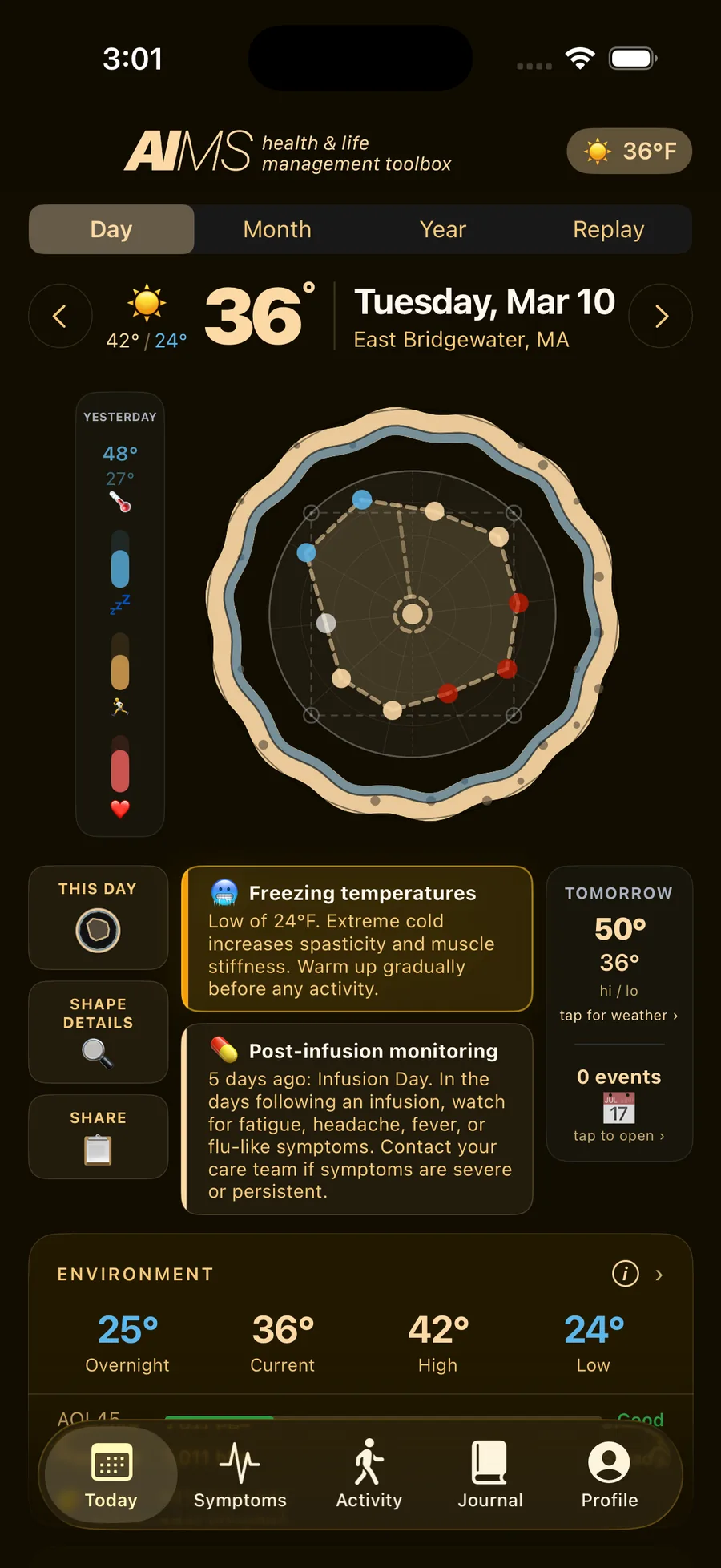
Zone, radar composite, and automated flags — one daily screen.
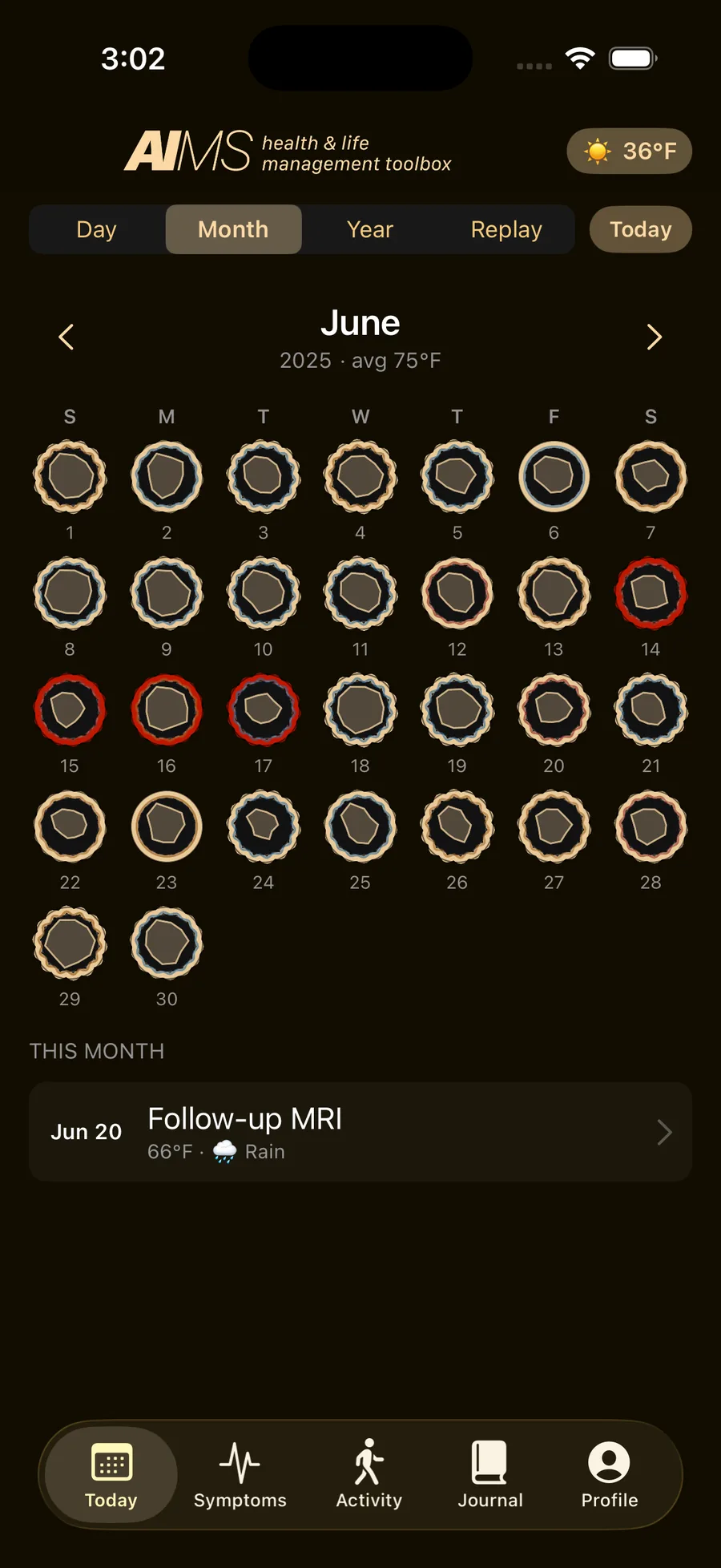
A month of zones at a glance — patterns visible without re-reading every day.
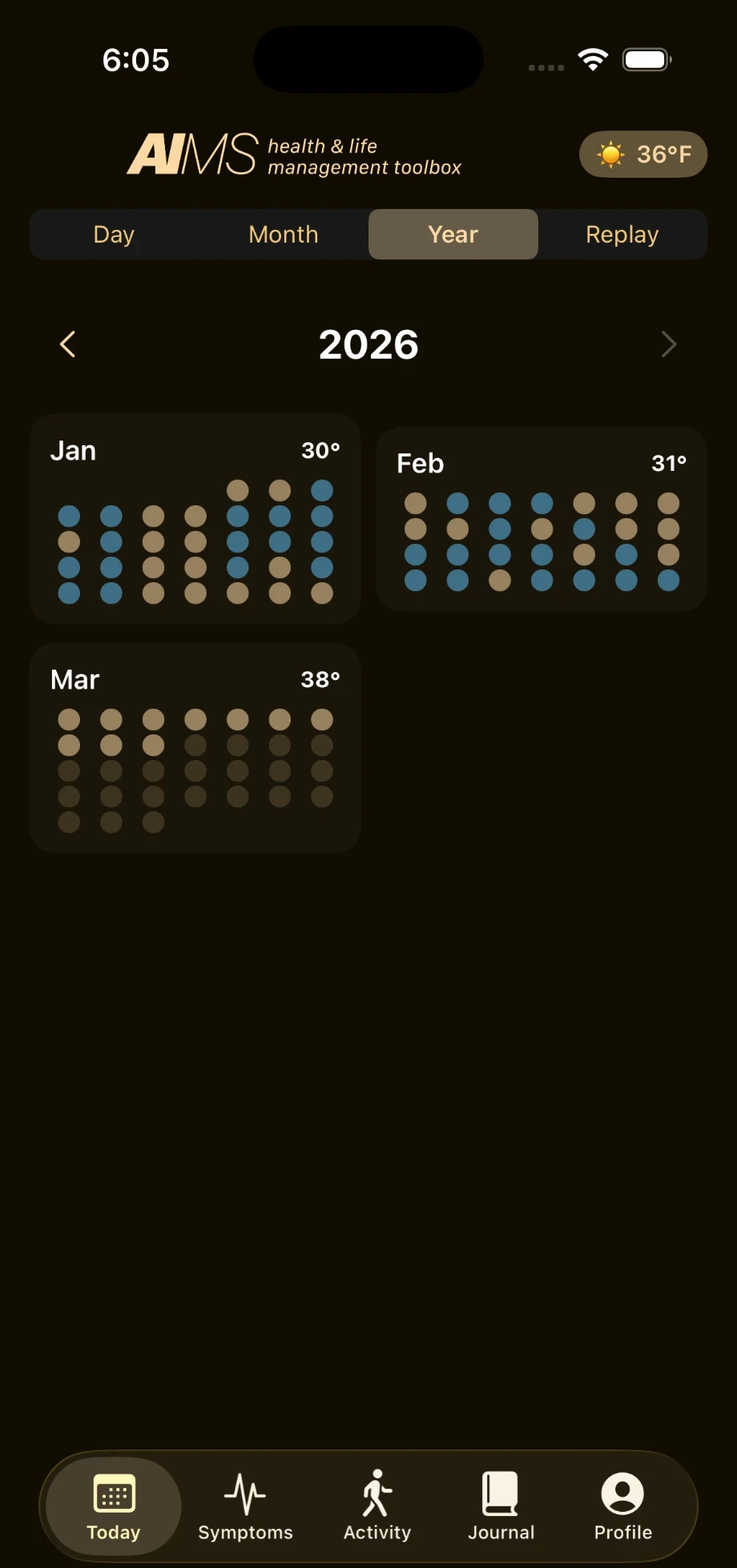
A year of zone history at a glance — long-run patterns a single month can't show.
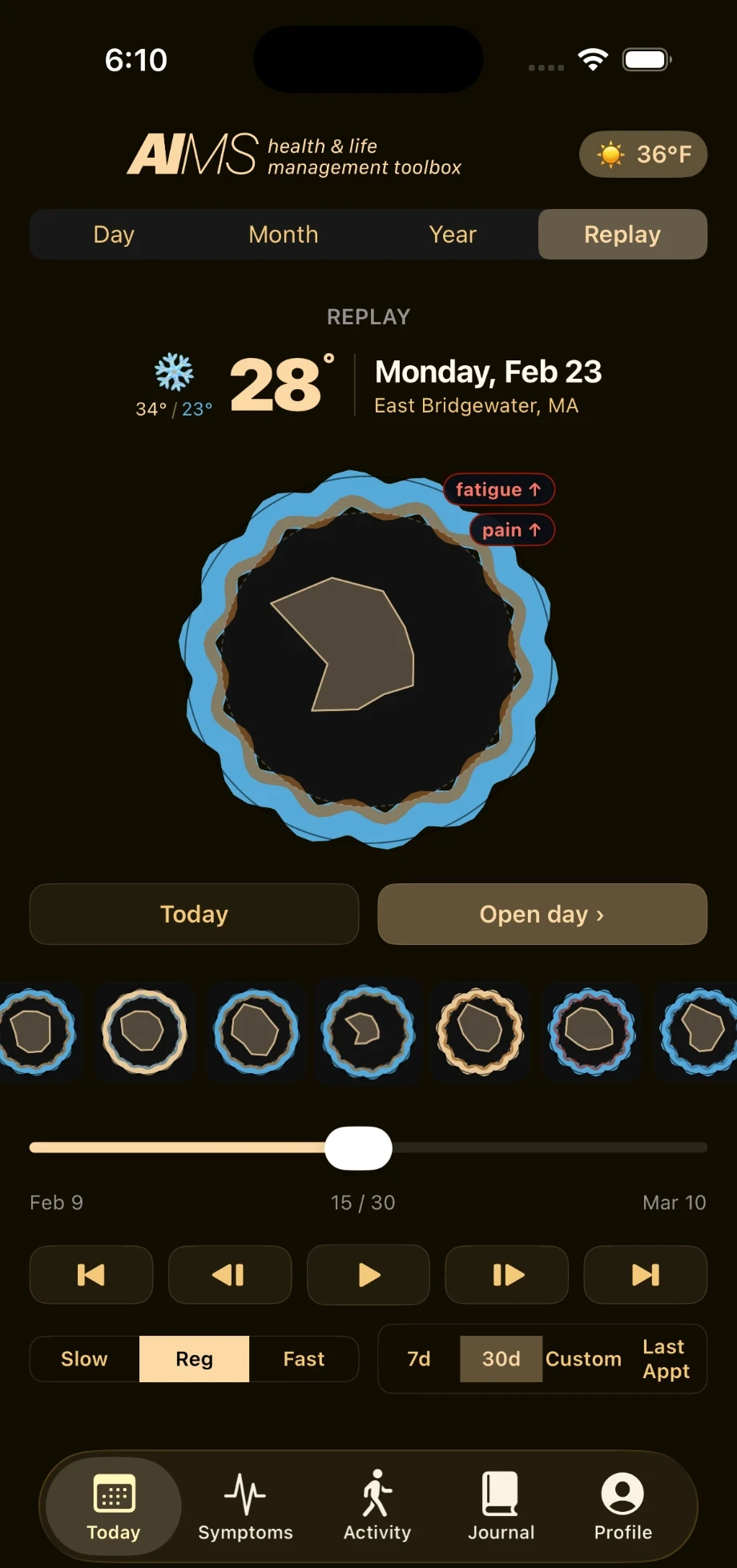
Scrub back through any stretch of days to see how a flare actually unfolded.
A record to leave behind, not a screen to scroll through.
Any logged range — a week, a month, a custom window, or everything since the last neurology visit — compiles into a plain-language summary: symptom averages, zone and temperature exposure, vitals, and events, built to be read in the few minutes before an appointment instead of scrolled through during one.
It leaves the app as an ordinary shareable file through the standard iOS share sheet — email, message, printed, whatever the care team already uses — and is labeled plainly for what it is: material for discussion, not a diagnosis.
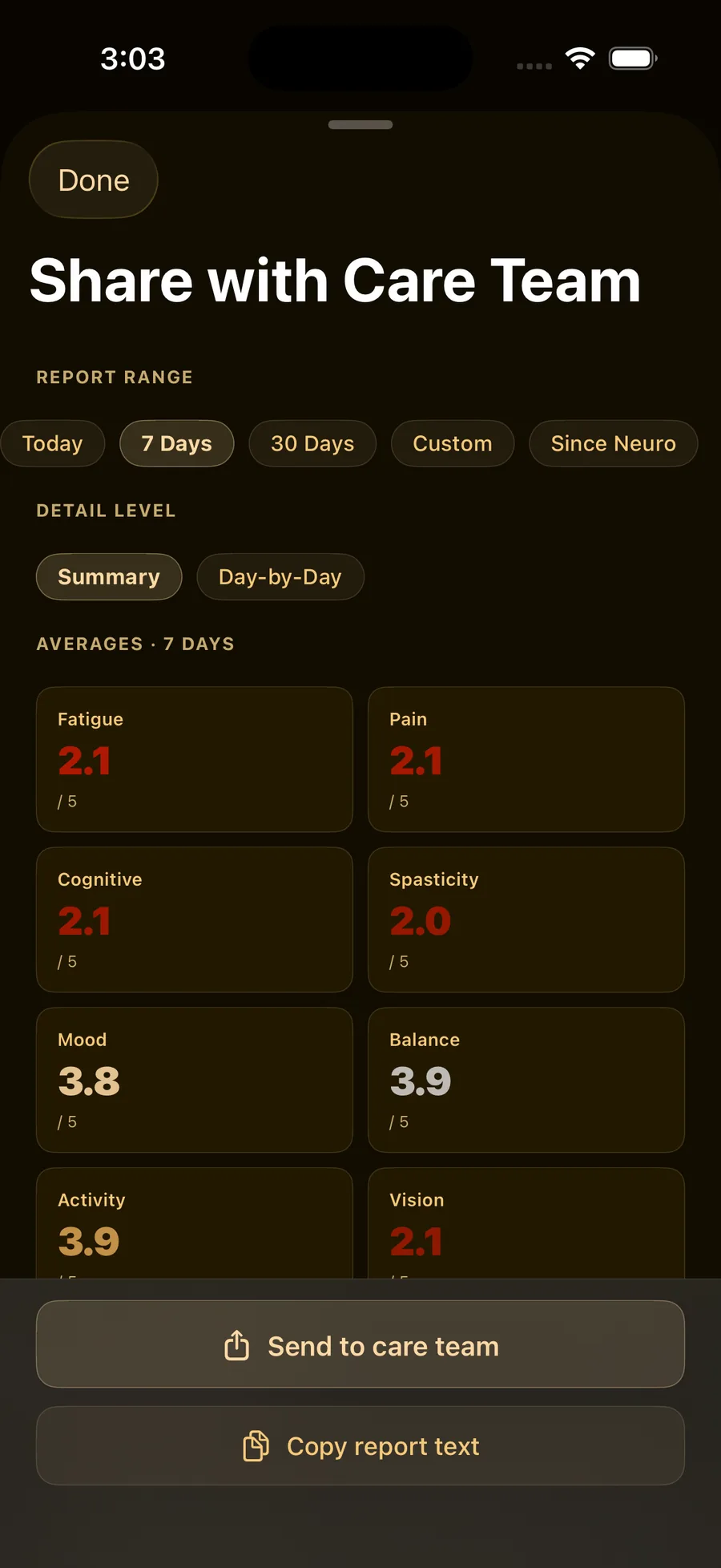
Pick the range and detail level.
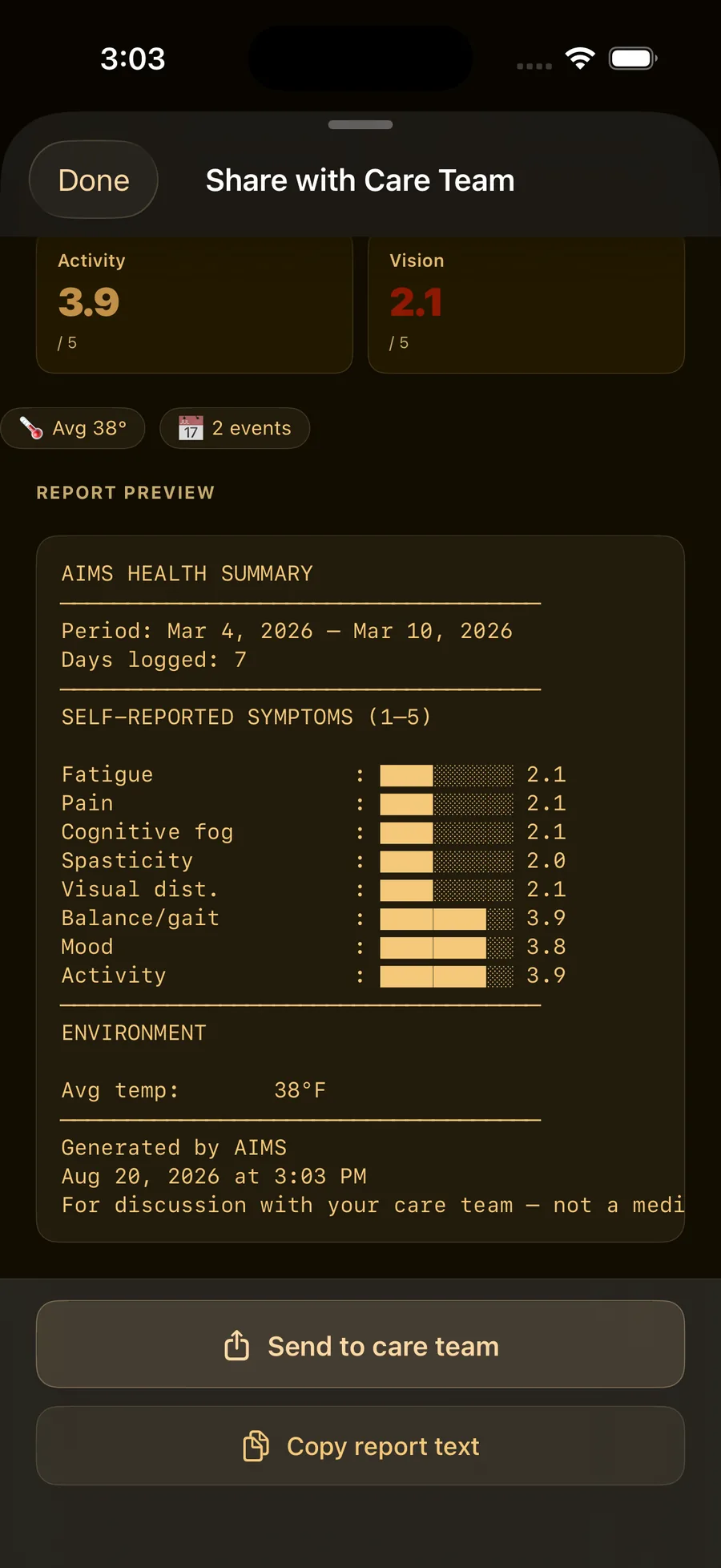
Get a plain-text report, ready to send.
Patient-generated data, structured the way research needs it.
AIMS is an early-stage, independently built project — one person's daily record of living with MS, not yet a company or a clinical product. There's no trial data, regulatory clearance, or existing pharma partnership to point to. What's here is a working iOS app, a data model built carefully enough to be worth a conversation, and IP protection already underway: a U.S. non-provisional patent application is pending, with a corresponding international application filed.
Let's talk about what this data could be worth to your work.
Open to conversations about research collaboration, real-world data partnerships, or simply a walkthrough of how AIMS is built.
erinlea_mcgowan-moniz@harvard.edu
built by Erinlea McGowan-Moniz